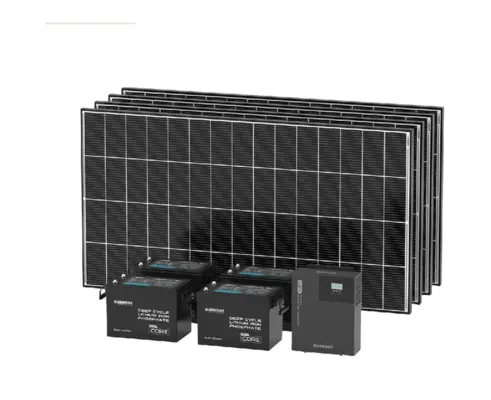
Every build in this series makes a quiet architectural decision before the first wire is cut: does this system stay 12V DC end to end, or does an inverter join to speak household AC? Get it right and the build is efficient and elegant; get it wrong and you're paying conversion tax to run lights, or discovering the table saw needs a component you didn't buy. Here's the honest comparison and the sorting rule that settles it per project.
The two architectures
Native 12V DC runs battery-direct: panel → controller → battery → fused branches to DC loads. No inverter means no conversion loss, no idle draw (inverters sip even at rest — a real tax on small batteries), no extra failure point, and no extra cost — but the loads must exist in 12V form. Happily, the 12V catalog is deep and mature, courtesy of the RV, marine, and trucking worlds: LED lighting, fans, pumps, compressor fridges, USB delivery, cameras, gate motors, timers, and relays all come 12V-native and excellent. AC via inverter adds the component that makes wall-plug appliances work anywhere: pure sine for anything with electronics (this site's standing rule), sized to the loads' running and surge demands, mounted at the battery on the short fat cables the wiring guide prescribes. The cost is the inverter itself, the conversion slice, the idle draw, and the heavier battery-side wiring its appetite demands.
Head to head
| Native 12V DC | AC via inverter | |
|---|---|---|
| Efficiency | Best — no conversion | Conversion slice + idle draw |
| Cost | No inverter to buy | Inverter + heavier wiring |
| Load catalog | Deep for lights/pumps/fans/fridges | Everything with a wall plug |
| Complexity | One voltage, simple | One more system to size and fuse |
| Failure surface | Minimal | The inverter is a real component |
| Natural builds | Lighting, security, fountain, gate, camera | Workshop tools, e-bike charger, kitchen appliances |
Where 12V wins outright
The sorting principle: if a good 12V version of the load exists, use it and stay DC. That single rule designs half this series. The shed lighting build is the flagship case — LED strips run battery-direct, and an inverter would add loss, cost, and idle draw to accomplish nothing. The security system (12V floods, buck-converted cameras), the irrigation pump, the fountain, the gate, and the chuck box's core (compressor fridge, lights, USB) are all native-DC builds, and their efficiency, simplicity, and battery mileage all trace to that choice. The supporting cast makes it painless: buck converters deliver clean USB and odd DC voltages from the 12V bus, and the fuse-block architecture distributes it all legibly. Small-battery builds feel the inverter's idle draw hardest, which is why the smallest systems are the most DC-dogmatic.
Where AC becomes non-negotiable
Some loads simply are AC creatures: power tools (the workshop guide's whole second act), the e-bike's manufacturer charger (the charging station's pure-sine centerpiece), kitchen appliances, and anything whose 12V version doesn't exist or exists badly. The inverter rules when it arrives: pure sine always; sized to running and surge demands (motors' startup multiples, per the sizing guides); switched so it sleeps when unused; and fed by battery cabling sized to its worst appetite — the heaviest wire in the whole hobby, and the place undersizing is least forgivable. The elegant pattern most mature builds converge on is hybrid: a DC backbone running the everyday loads at native efficiency, with a switched inverter branch that wakes for the AC occasions — the shed that lights on DC and saws on AC, the chuck box that runs its fridge on DC and could host a blender on request. Architecture, like the rest of this series, turns out to be a both-and wearing an either-or costume.
The power-station footnote
The integrated power stations this site reviews are the hybrid pattern productized: a DC battery core with native USB and 12V outputs and a built-in pure sine inverter, packaged and pre-fused. That's precisely why the DC-output habit from our runtime calculator and medical guides stretches their runtime — using the station's DC ports is choosing the efficient architecture within the product. Component builders and station owners are thus running the same playbook at different altitudes: DC where the load allows, AC where it must, and the inverter asleep the rest of the time.
Bottom line
Stay 12V wherever a good 12V load exists — which is most of this series — and add the pure sine inverter as a deliberate, switched, properly-cabled branch when a real AC load demands it. The architectures aren't rivals; they're layers, and the builds that feel effortless are the ones that put each load on the right one.
Frequently Asked Questions
Why not just use an inverter for everything?
Conversion loss, idle draw, cost, and an extra failure point — real taxes, heaviest on small batteries — to run loads that exist in excellent 12V versions. The inverter is for loads that need it, not a default.
What is a buck converter and when do I need one?
A small efficient DC-DC step-down that delivers USB voltages (or other DC levels) from the 12V bus — the component that lets cameras, phones, and electronics join a native-DC build without an inverter. Pennies, tiny, and everywhere in this series.
Does an inverter really draw power when nothing's plugged in?
Yes — idle draw is small per hour but continuous, and on a modest battery it sums to real capacity by morning. It's why every build here switches the inverter rather than leaving it listening.
Why must the inverter be pure sine?
Modified sine's choppy waveform runs simple resistive loads but stresses or confuses motors, chargers, and electronics — exactly the loads inverters exist for. Pure sine is the standing rule across this site's builds and reviews.
Can one system do both DC and AC?
That's the mature pattern: a 12V DC backbone for the everyday loads plus a switched pure-sine inverter branch for AC occasions. Most of this series' builds either start there or grow into it.