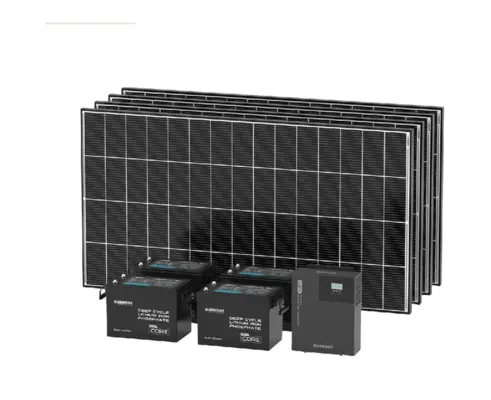
Before any backyard project earns a panel, it deserves the honest question this series usually skips past: should this thing be solar at all? Every remote load — the shed light, the gate, the camera, the fountain — has three candidate power sources: a solar system, a plain battery you swap or recharge, or a wire from the house. Each wins somewhere, and the losing choices are how projects end up over-built or under-powered. Here's the three-way, and the sorting questions that settle it.
The three candidates, honestly
Solar buys autonomy: harvest matched to load means indefinite operation, no trenching, no battery-swap chores — at the cost of the full component chain (panel, controller, battery, the wiring guide's disciplines) and a dependence on sun access that shaded sites can't negotiate away. Battery-only — a rechargeable pack, a power station visit, or swapped tool batteries — buys simplicity: no panel, no controller, no siting, just capacity and a charging routine; its cost is the chore itself, which scales with the load's appetite and your distance from the charger. The wire buys permanence: unlimited power, no weather dependence, no batteries ever — at the cost of trenching, conduit, code compliance (buried AC circuits are licensed-electrician territory in most jurisdictions; low-voltage landscape runs are the DIY-friendly exception), and a bill that scales brutally with distance. Distance is in fact the referee of the whole comparison: at the porch, the wire embarrasses solar; at the back forty, solar embarrasses everything.
Head to head
| Solar system | Battery-only | Run a wire | |
|---|---|---|---|
| Up-front cost | Moderate (the chain) | Lowest | Scales hard with distance |
| Ongoing effort | Seasonal glance | The recharge chore, forever | None |
| Power ceiling | Sized at build time | The pack you carry | Effectively unlimited |
| Weather/sun dependence | Needs sun access | None | None |
| Best distance | Anywhere with sky | Anywhere near a charger | Short runs only, economically |
| Permits/skills | Low-voltage DIY | None | Trench + code for AC |
The sorting questions
Four questions settle nearly every case. How far? Short runs near the house tilt hard toward the wire (or the existing outlet nobody checked for); past garden distance, trenching costs overtake a solar kit fast. How hungry? Trickle loads — cameras, lights, gates, fountains — are solar's sweet spot; heavy continuous loads (the workshop's saws, anything resembling heat) either justify the wire or the workshop-scale solar commitment, honestly costed. How much sun? The shaded north-side shed is a bad solar client no component upgrade fixes — battery-only or the wire serve shade better. How often visited? The battery-only chore is fine for the seasonal camp and absurd for the daily gate; visit frequency prices the swap routine. Run the four and most projects sort cleanly — and the ones that don't are usually hybrids in waiting.
Where each one is the obvious winner
Solar's landslides: the far and the frequent — the property camera, the driveway gate, the detached shed, the garden pump — daily-duty loads at trenching-hostile distances with sky overhead, which is precisely this series' roster. Battery-only's landslides: the occasional and the portable — holiday lighting, the workbench that gets used monthly, the party's sound system, the experiment phase of any project (running the future shed light off a power station for a month is the cheapest feasibility study in the hobby, per the buy-vs-build logic). The wire's landslides: the near and the hungry — the attached garage, the patio outlet, the heat-adjacent loads this site's solar math always votes against, and any location where an electrician's short run costs less than a battery's replacement cycle. The hybrid endgame shows up here too: many properties run the wire to one hub and let solar serve the satellites — which is just this comparison, applied per load instead of per property.
One modern footnote on the battery-only column: the power station quietly upgraded it. A station wheeled to the project for the weekend — then home to the closet and the outage plan — makes battery-only viable for loads that would have demanded solar a decade ago, and doubles as the feasibility-test instrument for any build on this list. For many households it's the first purchase in this entire comparison, precisely because it serves all three columns while you decide.
The battery-only column, productized
A Bluetti station is the swappable-battery option grown up — weekend project power, outage insurance, and the cheapest way to trial-run any build before committing panels to it.
Check Bluetti's current pricing →Bottom line
Distance, appetite, sun, and visit frequency — four questions, honestly answered, and the right power source names itself. Solar wins this series' projects because this series picks solar-shaped problems; the discipline is noticing when a problem isn't one, and saving the panel for the build that deserves it.
Frequently Asked Questions
Isn't running a wire always the most reliable option?
For power delivery, yes — but its cost scales hard with distance and its AC form needs trenching and code compliance. Reliability parity is exactly what a properly sized solar system buys at distances where the wire's economics collapse.
When is battery-only genuinely the right answer?
Occasional-use and portable loads, shaded sites, and the experiment phase of any project — where the recharge chore is rare enough to be free. Daily-duty loads convert the chore into the argument for solar.
Can I run an extension cord instead of trenching?
As a temporary measure only — permanent extension-cord feeds to outbuildings are a code violation and a genuine hazard in weather. Permanent AC wants proper buried circuit work; permanent everything-else is what this comparison exists to sort.
How do I know if my site has enough sun for solar?
Watch the candidate panel spot across a day (and imagine December's lower sun): consistent direct light for the middle hours is a good client; deep tree or building shade is a dealbreaker no hardware fixes. The site audit costs nothing and prevents the category's saddest builds.
What about solar for high-power loads like a workshop?
It's done constantly — but as a sized, costed commitment per our workshop guide, not a default. The comparison's honest rule: trickle loads make solar cheap; hungry loads make it a project, and the wire deserves a real quote first.