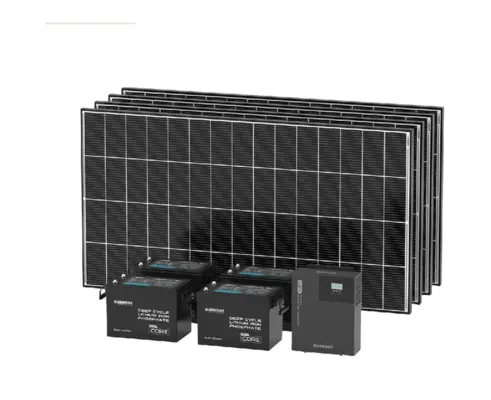
Two products now compete for the renter's first solar dollar, and they work in genuinely different ways. Balcony solar plugs into the wall and shrinks the electric bill every sunny hour; a power station with a folding panel banks sunshine into a battery you can point at anything — including a blackout. Both fit an apartment, neither needs a landlord's roof, and the right first buy depends on which problem you're actually solving. Here's the honest comparison.
Two different machines for two different jobs
Balcony solar is a bill tool. Panels on the railing feed a microinverter into an outlet, offsetting whatever the home draws in real time — the meter spins slower, automatically, every day, forever. No batteries, no management, no decisions after installation day. Its limits mirror its design: it helps only while the sun shines and the home draws, it stores nothing, and — critically — grid-tied microinverters shut down in an outage by design (anti-islanding), so it provides zero blackout protection. It's also the product with a legal dimension: qualifying systems are formally legal in a growing list of states and gray elsewhere, the landscape our balcony solar rules guide maps in full.
A power station is a resilience tool. The panel charges a battery; the battery runs whatever you plug into it, whenever — the campsite, the workbench, the CPAP, and above all the outage, where it's the entire Tier 2 strategy of our backup power guide. Its limits mirror its design: it offsets the bill only as much as you deliberately route loads through it, it involves ongoing participation (deploying panels, managing charge), and its solar harvest per dollar of hardware runs below the balcony system's set-and-forget efficiency. No legal dimension anywhere: charging a battery from a panel touches no interconnection rule in any state.
Head to head
| Balcony solar | Power station + panel | |
|---|---|---|
| Primary job | Shrink the bill automatically | Backup, portable power, banked sun |
| Blackout protection | None (shuts down by design) | The whole point |
| Effort after setup | Zero | Ongoing, modest |
| Legal status | State-dependent, improving fast | Unrestricted everywhere |
| Bill savings | Steady, automatic, daylight-long | Only what you route through it |
| Portability | Fixed to the railing | Goes camping, moves apartments trivially |
| Certification to seek | UL 3700 (or equivalent) | Standard product safety marks |
The decision tree
If outages are your anxiety, the power station wins outright — balcony solar contributes nothing when the grid drops, and that single fact settles most buyers who came to solar through a blackout. If the bill is your only target and your state has a law, balcony solar wins on pure economics — set-and-forget offset with no battery losses and no participation tax. If you're in a legal gray state, the power station is the zero-ambiguity path today, with balcony solar waiting on your legislature. If you camp, tailgate, or work off-outlet, the station's second life breaks the tie by itself. And if the honest answer is "both problems," the sequencing matters less than people fear — the two systems share nothing and stack cleanly, which is where most solar-curious renters eventually land anyway: railing panels shrinking the bill while the station sits charged for the storm.
The hybrid endgame
The mature renter setup runs both machines in their lanes: a certified balcony system (sized under the state ceiling, per the balcony solar reviews) doing silent daily bill work, and a power station (from the budget class up, per mission) holding the resilience line — with the folding panel doing double duty as the station's outage charger and the balcony system's portable cousin. Total footprint: one railing and one closet corner. Total landlord involvement: typically none for the station, lease-dependent for the railing. And when you move, everything moves with you — the whole portfolio is the rare home-energy investment that fits in a hatchback.
The resilience half, solved
For the power-station side of the renter's portfolio, Bluetti's compact-through-expandable lineup covers the closet-corner mission at every budget — and grows into real home backup if the next apartment has more outages than this one.
Check Bluetti's current pricing →One footnote on certification while shopping: the balcony side wants UL 3700 or equivalent per your state's law, while the station side wants the standard checklist from our budget guide — LiFePO4, pure sine, real solar input. Different products, different marks, same principle: buy the certified version of whichever half you're starting with.
Bottom line
Buy against your actual problem: the station for resilience (and everywhere the law is gray), the balcony system for automatic bill relief (where the law is ready), and eventually both, because they were never really competitors — just the two halves of what a renter's solar life looks like when it's finished.
Frequently Asked Questions
Does balcony solar work during a power outage?
No — grid-tied microinverters shut down when the grid drops (anti-islanding), by design and by certification requirement. Blackout protection is the power station's job; balcony solar is a bill tool.
Which saves more money: balcony solar or a power station?
On pure bill offset, balcony solar — it works automatically every sunny hour with no battery losses. A power station saves only what you deliberately route through it; its value is resilience and portability, not offset efficiency.
Can I use the same panels for both?
Not interchangeably — balcony systems use fixed panels wired to a grid-tie microinverter, while stations want portable panels on DC connectors. The folding panel can serve the station and travel; the railing panels stay married to the microinverter.
What should a renter buy first?
The one matching the actual problem: outage anxiety or gray-state law points to the power station; a legal state and bill focus points to balcony solar. Most solar-curious renters end up with both, and the order rarely matters in hindsight.
Is balcony solar worth it in a north-facing apartment?
Poor sun undermines the automatic-offset economics that justify it — a north-only exposure usually argues for the power station route, whose panel can chase sun at the park, the lot, or a friend's yard in a way railing panels never can.