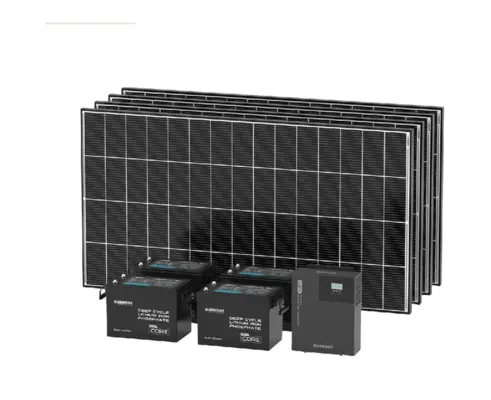
The moment a build's array grows past one panel, the wiring question arrives: series or parallel? The physics is two sentences, the consequences run through every multi-panel build in this catalog, and the wrong choice shows up as a cooked controller, a shade-crippled harvest, or copper money spent unnecessarily. Here's the comparison in full — the rules, the trade-offs, the shade plot twist, and the decision pattern the series' builds all follow.
The two-sentence physics, and what it buys
Series adds voltage: panels chained positive-to-negative sum their voltages while current stays at one panel's — the string running high-voltage, low-current. Parallel adds current: panels joined positive-to-positive sum their currents while voltage stays at one panel's — the bank running low-voltage, high-current. Everything else is consequence. Series' gifts: low current means thinner, cheaper wire and smaller losses over distance (the MPPT comparison's long-run argument, delivered), earlier morning wake-ups as the string clears the controller's start voltage sooner, and simpler two-wire home runs. Series' bill: the summed, cold-corrected Voc must clear the controller's input ceiling — the spec guide's classic winter failure — and the string demands an MPPT to convert its height back to battery voltage. Parallel's gifts: voltage stays panel-native (PWM-compatible, ceiling-proof) and the shade behavior below. Parallel's bill: summed current means fatter wire, branch fusing (multiple parallel strings can backfeed a faulted one — the fuse-per-string rule arrives at three strings), and heavier losses on long runs.
Head to head
| Series (string) | Parallel (bank) | |
|---|---|---|
| Voltage / current | Adds volts, keeps amps | Keeps volts, adds amps |
| Wire cost over distance | The economy — thin and cheap | The tax — thick and priced |
| Controller demand | MPPT, ceiling-checked cold | PWM-tolerant, current-rated |
| Partial shade | The string suffers together | Each panel fends for itself |
| Fusing | Simple | Per-string at three-plus |
| Morning start | Earlier (clears start voltage) | Later at low light |
| Natural home | Long runs, clean sky arrays | Shade-dappled sites, PWM builds |
The shade plot twist
Shade is where the comparison earns its article. A series string behaves like a hose with a kink: shade one panel and the whole string's current drops toward the shaded panel's — bypass diodes (built into decent panels) soften the collapse but don't repeal it — so the branch shadow that crosses one panel taxes the entire array. A parallel bank isolates the insult: the shaded panel underperforms alone while its siblings deliver full current. The consequence is the siting-and-topology rule the series' builds apply: clean-sky arrays — the roof rack, the open yard mount, the trailer's rack — take series' wire economics gratefully; shade-dappled sites — the tree-negotiated cabin, the partially blocked fence line the survey mapped — favor parallel's damage isolation, or the hybrid below. And the survey's deeper lesson repeats: no topology beats moving the array out of the shade, and the pole saw remains cheaper than the cleverest wiring diagram.
Hybrids, and the decision pattern
Real arrays past a few panels usually land on series-parallel: matched strings of two or three in series, those strings paralleled — voltage lifted into MPPT's happy range without threatening the ceiling, current tamed for the wire, shade damage contained to the afflicted string, and per-string fusing keeping the bank honest. The matching rule from the spec guide governs throughout: identical panels within a string, matched strings within the bank, because mismatches drag toward the weakest number. The decision pattern the series' builds follow, in order: check the controller's input window and the cold-corrected Voc math first (it eliminates options), price the wire run second (distance argues series), read the site's shade map third (dapple argues parallel), and let the hybrid resolve the ties. One panel: no question. Two to three: series if the sky is clean and the run is long, parallel if the shade or the PWM says so. More: the hybrid, fused per string, documented per the pillar. The topology settled, the wiring guide's liturgy takes over — and the array becomes, like everything else in this series, arithmetic that stopped being mysterious.
One bench note completes the topology chapter: the MC4 branch connectors that build parallel joints and the string jumpers that build series ones are cheap enough to stock both — and labeling the array's topology on the documentation card (with the per-string fuse values where they apply) is what makes next year's expansion a diagram-read instead of a re-derivation.
Bottom line
Series for volts, wire savings, and clean sky; parallel for shade isolation and PWM builds; the fused hybrid for real arrays that want both. Run the cold Voc check before anything, price the copper honestly, respect the shade map — and remember the comparison's standing footnote: the best topology is the one in full sun.
Frequently Asked Questions
Which is better, wiring panels in series or parallel?
Neither universally: series wins wire economics and long runs under clean sky; parallel wins shade isolation and PWM compatibility; real multi-panel arrays usually land on the fused series-parallel hybrid. The controller window, the wire run, and the shade map decide in that order.
Why did my controller die when I connected my series string?
Almost certainly the cold-Voc ceiling: series sums open-circuit voltages, cold mornings raise them further, and the total exceeded the controller's input maximum. The spec guide's cold-corrected math before connection is the prevention.
How does shade affect a series string?
Like a kink in a hose: one shaded panel drags the whole string's current down, bypass diodes softening but not repealing it. Parallel isolates the damage to the shaded panel — the core of the topology-by-site rule.
When do parallel strings need fuses?
At three or more strings, where a faulted string can sink its siblings' combined backfeed — the fuse-per-string rule. Two-string banks generally escape it; the panels' and controller's documentation confirms per system.
Can I mix different panels in series or parallel?
Reluctantly: series drags to the weakest current, parallel to the weakest voltage — mismatches waste the better panel either way. Matched panels within strings and matched strings within banks is the standing rule.